1. Commit to eating fresh fruits and vegetables in season. You don't have to do this all at once. I made gradual changes over several years. The first step is to read country of origin labels on produce before buying. Another step may be to stop buying fresh food that comes from a different continent.For me, eating seasonally started out as a conscious effort not to buy certain foods at certain times of the year. But as I adapted to the mindset, I developed new appreciation for fresh foods as they became available. The first fresh berries or melons or asparagus or broccoli taste so much better when you haven't eaten them for a while. I'm not much of a salad eater for most of the year, but in June and July I love the mixed greens that show up at farmer's markets.
2. Make an effort to cook from your refrigerator, not from your cookbooks. A friend who used to be an organic farmer changed my attitude when she gave me this advice a decade ago. Once you stop treating recipes like operating manuals, it's easier to substitute local foods for ingredients that would send you running to the supermarket.
For instance, many casseroles work well with different kinds of cheese, so try that local farmhouse variety instead of what's in the cookbook. Most Asian stir-fries or Indian curries can be adapted to whatever seasonal vegetables you have on hand. If the recipe calls for green beans, peas and cauliflower, chances are you can use carrots, zucchini or broccoli.
3. Shop at a farmer's market regularly. If you live in a mild climate, you may have these available year-round. In Iowa they only last from May through October. On the plus side, Iowa has more farmer's markets per capita than any other state, and that doesn't count the numerous roadside stands where you can buy produce.
4. Produce your own food. Grow some fruits and vegetables if you have a sunny spot in your yard, or access to a community garden plot. Our yard is too shady to do this, but many of my friends grow a lot of food in surprisingly small gardens.
Some people (even in cities) keep chickens for a fresh egg supply. Here's some good advice if you want to try that.
5. When food you love is in season, freeze or can large quantities so that you can enjoy it year-round. Alternatively, try to buy frozen fruits and vegetables that are packaged locally (or at least not halfway around the world).
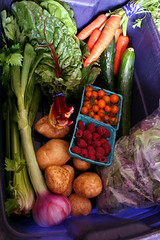
6. Join a farmer's buying club or CSA (community-supported agriculture) farm. Depending on the business model, you may receive a box of produce, eggs, meat or dairy every week, or you may get regular e-mail reminders about times to order and pick up food. Either way, you will be in regular contact with a farmer, and it will be easier to establish a habit of buying local.
Some people are intimidated by CSAs because they receive some food they've never eaten before and would never buy in a store. Here's where your cookbooks come in handy. You won't find a vegetable in your CSA box that isn't covered somewhere in Madhur Jaffrey's World Vegetarian, Diana Shaw's Essential Vegetarian Cookbook, or the New Basics Cookbook by Julee Rosso and Sheila Lukins.
7. Join a food cooperative if there is one in your area, or shop at an independent grocer who makes an effort to supply local food.


 Posts
Posts


 Image by DopT via Flickr
![Reblog this post [with Zemanta]](http://img.zemanta.com/reblog_e.png?x-id=72afe7bd-3802-4785-b948-044d4fbbacb2)


![Reblog this post [with Zemanta]](http://img.zemanta.com/reblog_e.png?x-id=6f57ac8f-b218-4ddb-a6a1-cc63d2d6723c)


