Showing posts with label Sustainable Agriculture. Show all posts

Friday, June 05, 2009

Buying Food Locally Helps Grow the Economy

Downtown Des Moines Farmers MarketImage by DopT via Flickr

An agriculture expert spoke at Marshalltown Community College about the benefits of buying food locally.

Ken Meter, President of Crossroads Resource Center based in Minnesota completed a study of food production in Marshall County. He discussed the potential economic benefits for the county of buying more food locally.

He noted that, according to numbers from the U.S. Census, which may not be totally accurate, only 46 farms sell directly to consumers in the county. Further, there are only 13 fruit orchards covering 25 total acres, and 13 vegetable farms covering only 43 acres.

Meter said there were some encouraging signs, such as the number of farms now selling directly to consumers increasing 35 percent in the past few years. Sales have increased 16 percent to approximately $228,000.

"It's a rising force and because it's a rising force, some efforts to cultivate that and let it occur seem appropriate," he said.

Still, Meter's research indicated Marshall County residents spend approximately $104 million each year on food. Nearly 90 percent of that is spent on things produced outside the area.

Finding ways to encourage direct interaction between producers and consumers will not only help locally by keeping more dollars in the community and creating jobs locally, it will help in other ways as well.

Stop by your local farmer's market over the weekend and enjoy some fresh food and help your local economy.
Reblog this post [with Zemanta]

Friday, May 29, 2009

Des Moines Register's Famer's Market Blog

The Des Moines Register has a blog online covering farmer's market in the Des Moines area.

Tom Perry interviews people who set up the stands and writes about the markets best finds. Last week, Perry wrote about the not-so green gardens...

Fresh, mushrooms, cultivated in Iowa, can be found at the Downtown Des Moines Farmers Market. Raised by Jim and Brein Osborn of Vinton, the mushrooms fall in to the exotic category. The oyster and shitaki look great every week.

The Osborns call their mushroom-growing venture: “Anything But Green Gardens.” Find their table this week on 4th Street, south of Court Avenue.

and about some of the more sweeter goods found at the Des Moines farmer's market...

We’re not talking any ice cream here. But Mike’s Old Fashioned Homemade Ice Cream, made with milk and cream from Iowa’s Cloverleaf Dairy. It is easy to find Mike’s spot at the market — he’s the one with the small 1929 John Deere Hit-and-Miss engine driving blades in two wooden buckets on the east end of Court Avenue, north side. This is a great place to see the basics of ice cream making.

Mike Pettit of Norwalk launched the ice cream venture in July 2005. In just a few seasons at the market, he and his ice cream have become a popular fixture.

This morning I tasted the vanilla. I know this is a bit of a cliche, but this ice cream really did remind me of the ice cream that I remember from back in the 1960s. Rich and creamy, but not overly so, and just the right touch of sweetness. The ice cream can be purchased with homemade strawberry or chocolate syrup.

If you plan to visit the Des Moines farmer's market, make sure to check out this blog.

Wednesday, May 20, 2009

Chickens are the New Cool Addition to your Backyard

Over the weekend, I read this article in the Washington Post about chickens being the cool addition to your backyard.

In cities across the United States, raising backyard poultry has suddenly become as chic as growing your own vegetables. It's all part of the back-to-the-land movement whose proponents want to save on grocery bills, take control of their food supply and reduce the carbon footprint of industrial agriculture.

The urban homesteading movement got a huge symbolic boost this spring when the first family installed a 1,100-square-foot vegetable garden at the White House. Poultry is the natural next step in the sustainable back yard; chickens produce eggs, devour kitchen scraps and add manure to the compost pile.

"Chickens are America's cool new pet," said Dave Belanger, publisher of the magazine Backyard Poultry. When he launched it three years ago, "we were thinking 15 to 20 thousand" subscriptions, he said. The print run for the bimonthly is now 100,000.

Belanger's magazine is published in Wisconsin, where five years ago chicken activists in Madison succeeded in getting the city council to reverse a ban on chicken coops. Madison's ordinance is typical of other cities'. You can raise chickens for eggs, not meat; they must be enclosed in a coop or run; and it's strictly a hen party: Roosters who crow day and night are prohibited

.

Friday, May 08, 2009

Eat Local

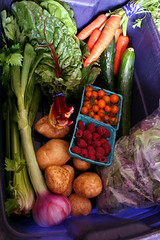
CSA 8 (187/366)Image by 427 via Flickr

Over at Bleeding Heartland, DesMoinesDem wrote about 7 ways to eat more local food.

I thought I'd post it here since many farmer's markets around the state are kicking off this month. Make sure to check out your local farmer's market tomorrow.
1. Commit to eating fresh fruits and vegetables in season. You don't have to do this all at once. I made gradual changes over several years. The first step is to read country of origin labels on produce before buying. Another step may be to stop buying fresh food that comes from a different continent.

For me, eating seasonally started out as a conscious effort not to buy certain foods at certain times of the year. But as I adapted to the mindset, I developed new appreciation for fresh foods as they became available. The first fresh berries or melons or asparagus or broccoli taste so much better when you haven't eaten them for a while. I'm not much of a salad eater for most of the year, but in June and July I love the mixed greens that show up at farmer's markets.

2. Make an effort to cook from your refrigerator, not from your cookbooks. A friend who used to be an organic farmer changed my attitude when she gave me this advice a decade ago. Once you stop treating recipes like operating manuals, it's easier to substitute local foods for ingredients that would send you running to the supermarket.

For instance, many casseroles work well with different kinds of cheese, so try that local farmhouse variety instead of what's in the cookbook. Most Asian stir-fries or Indian curries can be adapted to whatever seasonal vegetables you have on hand. If the recipe calls for green beans, peas and cauliflower, chances are you can use carrots, zucchini or broccoli.

3. Shop at a farmer's market regularly. If you live in a mild climate, you may have these available year-round. In Iowa they only last from May through October. On the plus side, Iowa has more farmer's markets per capita than any other state, and that doesn't count the numerous roadside stands where you can buy produce.

4. Produce your own food. Grow some fruits and vegetables if you have a sunny spot in your yard, or access to a community garden plot. Our yard is too shady to do this, but many of my friends grow a lot of food in surprisingly small gardens.

Some people (even in cities) keep chickens for a fresh egg supply. Here's some good advice if you want to try that.

5. When food you love is in season, freeze or can large quantities so that you can enjoy it year-round. Alternatively, try to buy frozen fruits and vegetables that are packaged locally (or at least not halfway around the world).

6. Join a farmer's buying club or CSA (community-supported agriculture) farm. Depending on the business model, you may receive a box of produce, eggs, meat or dairy every week, or you may get regular e-mail reminders about times to order and pick up food. Either way, you will be in regular contact with a farmer, and it will be easier to establish a habit of buying local.

Some people are intimidated by CSAs because they receive some food they've never eaten before and would never buy in a store. Here's where your cookbooks come in handy. You won't find a vegetable in your CSA box that isn't covered somewhere in Madhur Jaffrey's World Vegetarian, Diana Shaw's Essential Vegetarian Cookbook, or the New Basics Cookbook by Julee Rosso and Sheila Lukins.

7. Join a food cooperative if there is one in your area, or shop at an independent grocer who makes an effort to supply local food.

Reblog this post [with Zemanta]

Tuesday, June 24, 2008

Iowa Flooding Could Have Been a Man Made Disaster

The Washington Post had a story last week saying that the historic floods that hit Iowa might not be a natural disaster, but caused by human actions.

They quote Kamyar Enshayan, a college professor and Cedar Falls City Council member...

Enshayan, director of an environmental center at the University of Northern Iowa, suspects that this natural disaster wasn't really all that natural. He points out that the heavy rains fell on a landscape radically reengineered by humans. Plowed fields have replaced tallgrass prairies. Fields have been meticulously drained with underground pipes. Streams and creeks have been straightened. Most of the wetlands are gone. Flood plains have been filled and developed.

"We've done numerous things to the landscape that took away these water-absorbing functions," he said. "Agriculture must respect the limits of nature."

They discuss the changing nature of agriculture away from sustainable practices.

"I sense that the flooding is not the result of a 500-year event," said Jerry DeWitt, director of the Leopold Center for Sustainable Agriculture at Iowa State University. "We're farming closer to creeks, farming closer to rivers. Without adequate buffer strips, the water moves rapidly from the field directly to the surface water."

Corn alone will cover more than a third of the state's land surface this year. The ethanol boom that began two years ago encouraged still more cultivation.

Between 2007 and 2008, farmers took 106,000 acres of Iowa land out of the Conservation Reserve Program, which pays farmers to keep farmland uncultivated, according to Lyle Asell, a special assistant for agriculture and environment with the state's Department of Natural Resources (DNR). That land, if left untouched, probably would have been covered with perennial grasses with deep roots that help absorb water.

Tuesday, September 11, 2007

Tour of a Sustainable Agriculture Farm

Last week, my wife and I had the chance to tour High Hopes Gardens, a 7 acre farm just off Highway 330 west of Marshalltown. High Hopes grows a large variety of foods and flowers and uses sustainable practices. It was a definite learning experience for me.

Here are some pictures from the tour.

This trellis has gourds growing on it. Thought it was a cool picture with the sun and birdhouse in the background.

They grow many varieties of flowers and sell bouquets. Here are some Zinnias.


The Raspberry patch was huge. There is an old Mulberry tree in the background that they considered cutting down when they bought the place and plant some apple trees. However, they kept the Mulberry tree because the birds like to eat the Mulberries and they stay out of the Raspberries.


Here is a water tank they bought at an auction. It collects rainwater that runs off the barn and they use the water to water the plants around the farm. A half inch of rain fills up the tank.


They have some chickens. Here they are in a little pen that keeps the dogs and other larger animals out and the chickens in. They rotate the pins around the farm, so one area doesn't get worn down.

And they have 3 goats. They said they'd like to get another female and use the milk for cheese and things. However, these 3 help weed and clean up the gardens in the fall.


Here is a picture of one of their garden plots.

They also have 2 bee hives and they have gotten 16 gallons of honey this summer.

Check out the High Hopes blog to read more about the farm.

Sunday, September 02, 2007

Iowa Farmers Prevented from Diversifying Crops by Federal Rules

Iowa farmers who want to diversify the crops they grow and provide local food are prevented from doing so by federal agriculture rules.

From Eat Local Challenge...

Iowa farmer Gary Boysen grows sweet corn, peppers, tomatoes, cantaloupes and other produce on 65 acres near Harlan. He sells his produce at nearby supermarkets and Wal-Mart. And he would like to be growing more fruit and vegetables for Iowans. However, a big obstacle is standing in his way: federal agricultural rules.

If farmers want to plant fruit and vegetable crops on land enrolled in USDA subsidy programs, they must permanently give up the possibility of receiving benefits. Not just for the period when they are growing non-program crops. Permanently.

Many people want to buy locally produced fruits and vegetables and this rule is preventing farmers from providing that. If Iowans would diversify their agriculture, a lot of money could be kept in the state.

These rules seem to favor large commercial farmers that want to keep their access to markets across the country. For example, large tomato farmers in California wouldn't want Iowa farmers to grow tomatoes and sell them in Iowa because they would lose out. Hopefully, these rules can be changed in the Farm Bill.

Sunday, June 17, 2007

The age of the 3000-mile-caesar salad is coming to an end

A new study concludes energy has a greater impact on rising food prices than rising corn prices does.

Energy costs have a much greater impact on consumer food costs as they impact every single food product on the shelf,” said Urbanchuk. “Energy is required to produce, process, package and ship each food item. Conversely, corn prices impact just a small segment of the food market as not all products rely on corn for production. While it may be more sensational to lay the blame for rising food costs on corn prices, the facts don’t support that conclusion. By a factor of two-to-one, energy prices are the chief factor determining what American families pay at the grocery store.
Purchasing food grown locally on farms that grow a diverse range of crops is the wave of the future. As gas prices rise, we will no longer be able to depend on food grown on gigantic factory farms in a few parts of the nation. Shipping lettuce to Iowa from California will no longer be affordable. The age of the 3000-mile-caesar salad is coming to an end.

Tuesday, June 05, 2007

Food and Farm Bill of Rights

Rep. Earl Blumenauer (D-OR) is guest blogging at TPM Cafe this week and he wrote about the upcoming farm bill. Blumenauer discusses a Food and Farm Bill of Rights. Now I am hardly the one to dissect farm policy, but the I like the core ideas of limiting special interests, promoting sustainable practices such fiscal resonsibility and growing local foods.

That’s why I’m embarking on an effort to promote a Food and Farm Bill of Rights:

  1. Americans have a right to a policy free of special interest giveaways: Current farm policy favors corporate special interests. Fully 70 percent of the payments go to the top 10 percent of farmers, and even more of that benefit is concentrated for the large processors. What’s more, aid is so concentrated in a few powerful states that the support received by most states is almost negligible. We deserve a food and farm policy that serves all Americans, not just the politically-connected.
  2. American taxpayers have a right to a fiscally responsible policy: Today’s Farm Bill contains some of the federal government’s largest programs. We deserve a food and farm policy that ensures our tax dollars are invested in fiscally sound policies and programs that fit in with the priorities of the American farmer and taxpayer.
  3. Americans have a right to a policy that serves all farmers: Our current farm policy ensures high profits for a few select commodities while neglecting the needs of many other valuable commodities and smaller producers. In fact, 60 percent of America ’s farmers and ranchers get no support whatsoever. We deserve a food and farm policy that supports producers and helps them access new local markets, thereby generating jobs by adding value to their products.
  4. Americans have a right to a safe and healthful food supply: Recent crises in food supplies (Hurricanes Katrina and Rita) and food safety (fresh spinach and tainted pet foods) are painful reminders of the vulnerability of our food supplies and distribution systems. We deserve a food and farm policy that guarantees a safe and healthful food supply in this country, in good times and in bad.
  5. American children have a right to good nutrition: Children who are hungry perform poorly in school and are at greater risk for long-term health problems. We deserve a food and farm policy that makes sure our children are well nourished by allowing more healthful choices and opening up access to fruits and vegetables.
  6. Americans have a right to local supplies of fresh food: Too many Americans do not have the option of buying affordable, locally-grown fresh food. We deserve a food and farm policy that includes programs that deliver healthy food to all communities, regardless of location, class, or economic standing.
  7. Americans have a right to a policy that promotes energy independence: The pursuit of heavily subsidized corn-based ethanol is a fool’s game fueled only by massive government subsidies and regulations not justified by the science or economics. We deserve a food and farm policy that enables our farmers and ranchers to produce vast quantities of renewable energy: wind, solar, in some cases small-scale hydro, geothermal and biomass.
  8. Americans have a right to a policy that protects the environment: Virtually every urban area is surrounded by productive farmland that also provides important environmental services – wildlife habitat, carbon sinks, clean water – as well as landscapes and vistas that define our sense of place. We deserve a food and farm policy that promotes good stewardship of the environment and our natural resources.
  9. Americans have a right to preserve farmland from sprawl: In many areas of the country the pressures of sprawl are forcing farmers off of their land. We deserve a food and farm policy that gives farmers the tools they need to protect their land – and our heritage – from development pressures.
  10. Americans have a right to a policy that fosters sustainable farming practices: The current farm policy offers conflicting messages about good farming practices, sometimes promoting sustainable practices while other times offering incentives that undermine the long-term health of our soil and water resources. We deserve a food and farm policy that enables farmers to be responsible with their land so that they can pass it on to the next generation.

Wednesday, May 02, 2007

Midweek Homework: Checking in with the Iowa blogs

Over the past couple days there has been some great posts on Iowa blogs that are definitely worth the read.

Yesterday, John Deeth covered a May Day Peace event in Iowa City.

Organizers of Tuesday's Missing May Day peace events in downtown Iowa City had energy beyond numbers. It was a "spiritual event," said one speaker and the message was simple: end the war now - no deadlines, no conditions - now, was the call of the day.

Initially discussed weeks ago as a relatively routine picket, the event evolved into a festival, a Peace-a-palooza if you will.

The event wasn't really about the speeches, it was about young, young, young. Most organizers and attendees were in their 20s or even teens.
Popular Progressive wrote about how the declining honey bee population affects Iowa agriculture.

Essential Estrogen has an in depth look at State Rep. Dawn Pettengill's defection to the GOP that includes an analysis of Pettengill's voting record.

Finally, The Woodbury Democrat asks if we have lost the war.
What an absurd question!

No, the U.S. hasn’t lost the war. In fact, we won it four years ago. We defeated Saddam Hussein’s Republican Guards with relative ease, and overthrew one of the Middle East’s most legendary tyrants. End of story.

The problem is, we’re asking the wrong question. More specifically, we Americans are approaching the continuing troubles in Iraq from the wrong direction. We (meaning the citizens of the United States of America) have not, and never will, lose the war in Iraq. Why? It is not our war because it is not our country! Iraq isn’t ours to lose today, any more than China was ours to lose in 1949.

Sunday, July 09, 2006

Breezing through the Register

The Des Moines Register had some interesting articles today. Here they are...

We can continue to support casinos, hog-confinement and slaughter houses in the state of Iowa, or we can provide sustainable, family-centered jobs that encourage a healthy environment.

We can lay our money down on more stinking air, lost farms, and lost fingers, or we can embrace the new agriculture.

My generation has begun a change. We've stopped chasing our losses and have returned to the simple idea of growing, selling, and consuming our own food within our own borders. We've led the way with pesticide-, hormone- and drug-free products. But we can't continue this journey on our own. We need young Iowans to travel with us.