Showing posts with label New Urbanism. Show all posts

Sunday, May 31, 2009

James Howard Kunstler: The Tragedy of Suburbia

I have posted a couple of times the past week promoting new urbanism and smart growth and thought I'd share this speech from James Howard Kunstler given at the TED conference a few years ago.


As I wrote on Saturday, now is the time to reconsider how are cities and towns develop...
While we are facing an economic downturn, now is the time where cities can promote infill development, new urbanism principles, and more bike/pedistrian-friendly in their development patterns.
... and build places worth caring about.

Saturday, May 30, 2009

American Academy of Pediatrics Prescirbe Smart Growth

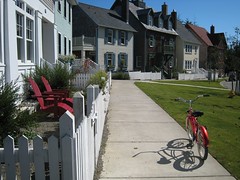
Seabrook 08'0914 - 135Image by studio-d via Flickr

Interesting announcement from the American Academy of Pediatrics.

From Smart Growth Around America...

Yesterday, the American Academy of Pediatrics adopted a ground-breaking policy statement on the link between how we build communities and the health of the children in those communities. The American Academy of Pediatrics policy:

  • reviews the many links between community design and overall child health, and the strong statistical validation of those links;
  • encourages pediatricians to work with parents to promote more walkable, livable communities,
  • calls on cities, states, and the US government to plan for and invest in communities that best advance the health, safety, and well being of American families.

This is really remarkable: the nation’s leading group of pediatricians saying, based on the evidence, that the way we’re building isn’t good for kids.

While we are facing an economic downturn, now is the time where cities can promote infill development, new urbanism principles, and more bike/pedistrian-friendly in their development patterns.
Reblog this post [with Zemanta]

Tuesday, May 26, 2009

Cul-de-sacs: The Greatest Threat to Our Planet

This video was the winner of this years Congress of New Urbanism video contest.

Friday, December 26, 2008

Rebuilding the Suburbs

Earlier this month I wrote about suburbs turning into tomorrows slums as the number of foreclosures increase, higher gas prices, and more demand for walkable neighborhoods.

Mesa, Arizona is doing something about this and wants to rebuild their image from a suburb known for sprawl into a livable community.

How do you remake a city of sprawl. That’s exactly what the city of Mesa, Arizona is trying to do, according to The Economist. Mesa has experienced tremendous growth in the past several decades, surging from 7,000 in 1940) to roughly 450,000 today. While many people still haven’t heard of it, Mesa numbers among the nation’s 50 largest cities, bigger than Minneapolis, Pittsburgh, Cleveland, or Miami. It’s a classic “edge city” which, as The Economist writes, consists of: “Mile after mile of strip malls and tract houses, whose evocative names and fanciful architecture cannot disguise the fact that they are large, stucco-covered boxes, dominate the landscape.”

Now Mesa is working hard to turn itself into a more liveable city. To bolster its economy, it’s constructing a new airport downtown (to better connect itself to the world - recall the Phoenix-Tuscon area is one of the world ’s 40 biggest mega-regions) in an effort to remake itself as what University of North Carolina’s John Kasarda calls an “aerotropolis” – the thinking being that air transport today is analogous to what canals, railroads, and cars were to past urban systems. Even more interesting is the city is investing heavily in improving its quality of place - urban design, mixed use development, strict building heights, increased density, warehouse conversions, and an extensive network of urban neighborhood parks in an effort to improve its ability to lure talent and jobs.

Read more here.

Tuesday, December 02, 2008

Tomorrow's Slums

A large number of foreclosures, high gas prices, and a greater demand for walkable neighborhoods could make today's suburban homes into tomorrow's slums.

For 60 years, Americans have pushed steadily into the suburbs, transforming the landscape and (until recently) leaving cities behind. But today the pendulum is swinging back toward urban living, and there are many reasons to believe this swing will continue. As it does, many low-density suburbs and McMansion subdivisions, including some that are lovely and affluent today, may become what inner cities became in the 1960s and ’70s—slums characterized by poverty, crime, and decay. [...]

If gasoline and heating costs continue to rise, conventional suburban living may not be much of a bargain in the future. And as more Americans, particularly affluent Americans, move into urban communities, families may find that some of the suburbs’ other big advantages—better schools and safer communities—have eroded. Schooling and safety are likely to improve in urban areas, as those areas continue to gentrify; they may worsen in many suburbs if the tax base—often highly dependent on house values and new development—deteriorates. [...]

But much of the future decline is likely to occur on the fringes, in towns far away from the central city, not served by rail transit, and lacking any real core. In other words, some of the worst problems are likely to be seen in some of the country’s more recently developed areas—and not only those inhabited by subprime-mortgage borrowers. Many of these areas will become magnets for poverty, crime, and social dysfunction.

Saturday, June 21, 2008

The Changing American Dream: From Surburbia to Walkable Neighborhoods

High gas prices, long commutes, and the subprime mortgage crisis have hit Surburbia hard and people have started to rethink where they want to live. People are now finding walkable urban areas and walkable neighborhoods more attractive instead of a house in suburbia.

"The American dream is absolutely changing," he told CNN.

This change can be witnessed in places like Atlanta, Georgia, Detroit, Michigan, and Dallas, Texas, said Leinberger, where once rundown downtowns are being revitalized by well-educated, young professionals who have no desire to live in a detached single family home typical of a suburbia where life is often centered around long commutes and cars.

Instead, they are looking for what Leinberger calls "walkable urbanism" -- both small communities and big cities characterized by efficient mass transit systems and high density developments enabling residents to walk virtually everywhere for everything -- from home to work to restaurants to movie theaters.

The so-called New Urbanism movement emerged in the mid-90s and has been steadily gaining momentum, especially with rising energy costs, environmental concerns and health problems associated with what Leinberger calls "drivable suburbanism" -- a low-density built environment plan that emerged around the end of the World War II and has been the dominant design in the U.S. ever since.